Table of Contents
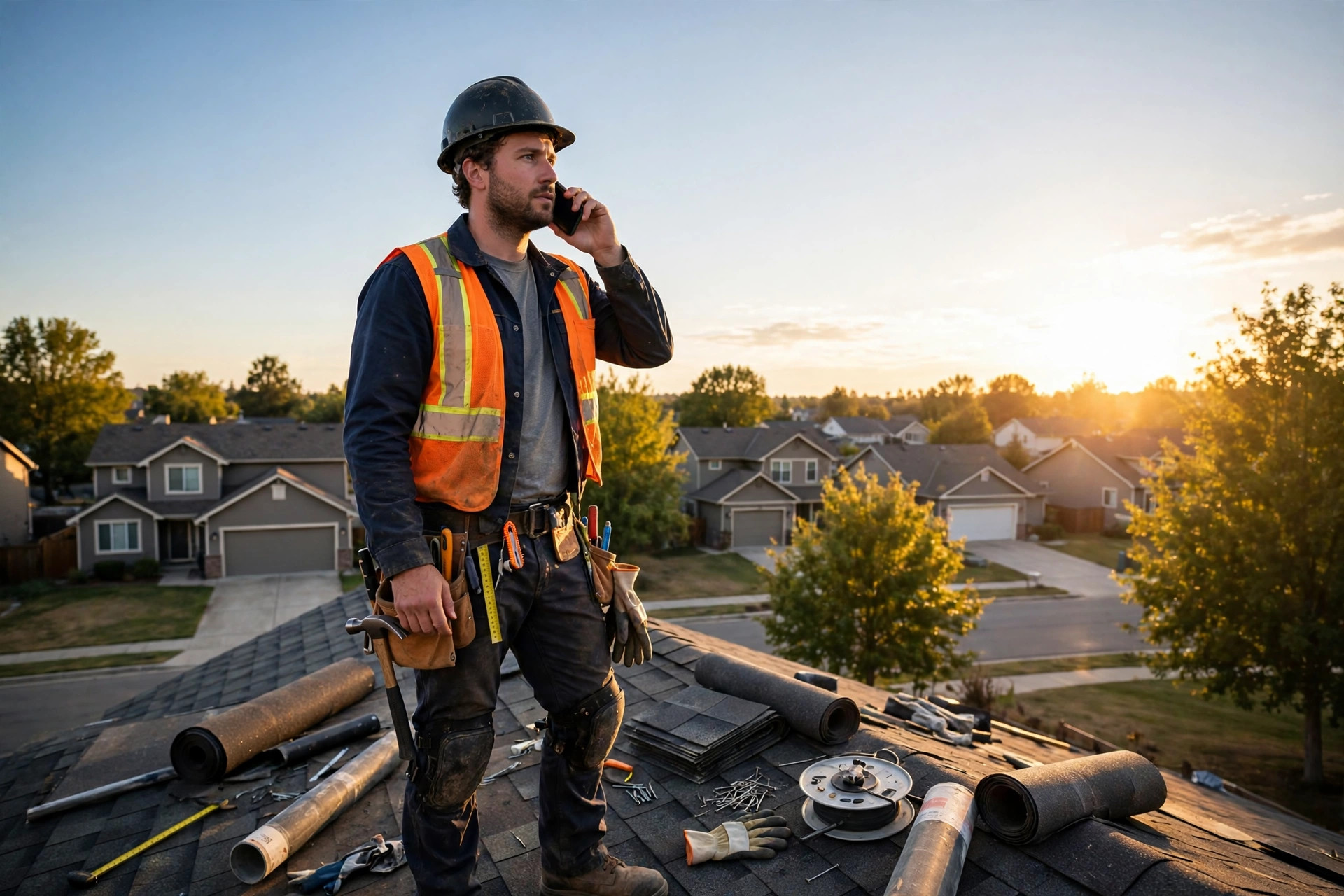
It’s 11 p.m., a hailstorm just rolled through, and your phone is ringing off the hook. You’re on a roof. Your crew is on a roof. Nobody’s answering, and every call that hits voicemail is a homeowner dialing the next roofer on the list.
An AI receptionist for roofers fixes that one problem. It picks up every call in your company name, figures out whether it’s a real leak or a price shopper, books the inspection, and texts your on-call crew when water is actually coming through someone’s ceiling. Here’s what it does, what it should never say, what it costs with real prices, and how to get one running this week.
What an AI receptionist for roofers actually does
Forget the sales pitch. On a roofing call, the job is five things, in this order:
- It answers. First or second ring, 24/7, and it says it’s an automated assistant. No voicemail. No hold music.
- It sorts the call. Active leak, new roof quote, repair question, insurance claim, spam. Each one goes down a different path.
- It asks the right questions. Address, roof type, storm date, where the water’s coming in, whether there’s a claim open. The stuff your estimator actually needs.
- It books the inspection. Straight into your calendar while the homeowner is still on the phone, not a message you return tomorrow when they’ve already booked someone else.
- It hands off real emergencies. A leak gets flagged and texted to whoever’s on call, with the address attached. Everything gets logged with a transcript you can read later.
That’s it. If a tool can’t do those five things, it’s not built for roofing, no matter what the landing page says.
The 3 things it must never say on a roofing call
This is where most AI phone answering for roofers goes wrong. The rules matter more than the features.
Never quote a price for a roof. Pitch, layers, decking condition, access, it all changes the number. A price said on the phone becomes the price the homeowner holds you to, and you’ll eat the difference. BuiltWithAgents puts it the same way in their roofing setup guide: the agent’s job is to book the visit, not to price the job.
Never promise a tarp time or an insurance outcome. Only your crew decides when a tarp goes on. Only the insurer decides what’s covered. An agent that promises either one is writing checks you have to cash.
Never take policy numbers or card details. Whether there’s a claim open, yes or no, that’s fine. The numbers stay off the call.
Best AI receptionist for roofers: real prices compared
Prices below come from each vendor’s own pricing page, as checked in October 2026. They change, so confirm before you buy. Goodcall, Rosie and Marlie prices are from FieldCamp’s roofing comparison, which checked them the same month. The best AI receptionist for roofing isn’t the cheapest one. It’s the one that fits how your phones actually behave.
| Service | Entry price | How you’re billed | Best for |
|---|---|---|---|
| AgentZap | $109/mo + $499 setup | Per minute (150 min) | Done-for-you setup and scripting |
| Goodcall | $79/mo | Per unique caller (100 callers) | Storm surges, long calls don’t punish you |
| Rosie | $49/mo | Per minute (250 min) | Cheapest flat entry; Scale at $149/mo books on your calendar |
| Smith.ai | Free for 25 calls/mo | Per call; Pro $150/mo (75 calls) | Human backup when a call gets complicated |
| Dialzara | $29/mo | Per minute (60 min) | Cheapest way in; every overage rate published |
| Roofr AI Receptionist | $99/mo | 200 minutes included | Roofers already running Roofr; 30 days free |
| Marlie AI | $49/mo | Per minute (250 min) | Storm capacity with AccuLynx and JobNimbus sync |
Roofing AI receptionist cost: what actually drives the bill
Entry plans run $29 to $150 a month. But the sticker price isn’t the bill. The billing model is.
Per-minute plans are cheap in a quiet month and brutal in a hail week. One 20-minute insurance call costs real money on every minute. Per-caller plans like Goodcall don’t punish long calls, but a surge of different callers does. Per-call plans are predictable, unless hang-ups get billed as calls.
Run your worst month before you pick, not your best one. A quiet month might be 45 calls and 225 minutes. A hail month can be 240 calls and 1,320 minutes. On a per-minute plan that month can triple your bill. On a per-caller plan it stays roughly flat. AI subscription pricing keeps shifting across the board, so re-check the numbers the month you sign up.
For scale, a live answering service costs far more. Ruby starts around $250 a month for 50 minutes. PATLive runs about $99 a month plus per-minute charges. A human receptionist is $300 or more a month and still doesn’t cover nights without overtime. A do-it-yourself build on Vapi is estimated at $82 to $129 a month per 1,000 minutes, plus your build time. An AI answering service for roofing companies sits well under all of that, and it books the job instead of taking a message.
AI receptionist vs a live answering service
Here’s the honest trade-off. An AI receptionist for roofers wins on speed and cost: it answers instantly, handles unlimited calls at once, books the inspection, and runs $29 to $150 a month. It loses on judgment. An upset homeowner or a tangled insurance claim still needs a person.
A live service wins on judgment and loses on price and surge capacity. The middle ground is a hybrid like Smith.ai: AI answers first, a live agent steps in when the call gets complicated. If insurance calls dominate your phone, the hybrid is worth the extra money.
How to get one running this week
You don’t need a developer, and you don’t need a month. An AI receptionist for roofers goes live in a week if you do the steps in order.
- Write your leak rule first. What counts as an emergency, who gets the text, and what the agent must never say. Test this before storm season, not during it.
- Pick the billing model for your call pattern. Quiet months or storm months, that’s the decision.
- Connect your calendar. Google Calendar or Outlook, so it books inspections instead of taking messages.
- Call your own number at 11 p.m. Three stories: a leak, a price shopper, and a wrong number. Listen to all three recordings.
- Read every transcript for two weeks. Fix the script once, then leave it alone.
Most small businesses are still early on AI, and the adoption numbers show most owners haven’t built it into how they work yet. That gap is the opening: the roofer who answers every storm call wins the job, and right now most roofers don’t.
FAQ
Will an AI receptionist book roof inspections?
Yes. The good ones book into Google Calendar, Outlook, JobNimbus, AccuLynx or Roofr while the caller is still on the phone, and send a confirmation text.
What happens when a real leak calls at 2 a.m.?
It flags the emergency, texts your on-call crew with the address and the details, and never promises a time. The crew decides the response.
How much does an AI receptionist for roofers cost?
Most roofing companies pay $29 to $150 a month, depending on call volume and billing model. Free ways to test exist: Smith.ai has a free tier for 25 calls a month, and Roofr offers 30 days free.
Do I still need a human answering the phone?
For upset homeowners and complex insurance calls, yes. That’s what hybrid services are for: AI first, a person when it matters.
Want to hear one work on your own number? Techryza sets up a free test AI receptionist for roofers. It answers your calls, books inspections, and you decide after hearing it work. More practical AI guides for small business are on the site.
Prices in this post come from each vendor’s public pricing page, as checked in October 2026. Verify on the vendor’s site before you buy.